

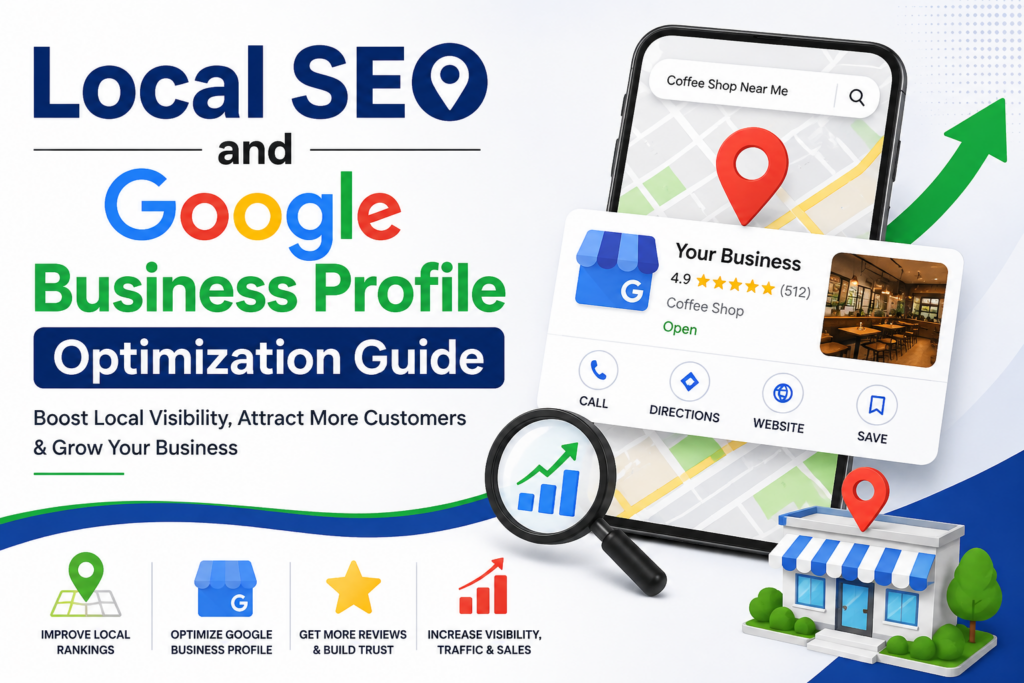
Local SEO (Local Search Engine Optimization) is the process of optimizing your online presence so your business appears prominently in local search results on Google, Google Maps, and other search engines when people nearby are searching for your products or services.
Unlike traditional SEO, which focuses on ranking nationally or globally, Local SEO targets a specific geographic area — your city, neighborhood, or region — making it the most powerful digital marketing strategy for businesses that serve local customers.
Real Example
When someone in Miami searches “pool heating service near me” or “pool heater repair Miami,” — Local SEO determines whether your business appears in the top results or gets buried on page 3.
Why Local SEO Matters for Your Business
The numbers are clear — local search drives real business results:
Statistic
Figure
Impact
Google searches with local intent
46% of all searches
Massive audience opportunity
Users who visit within 24 hours
76% of local searchers
High purchase intent
Local searches that lead to sales
28% conversion rate
Strong ROI vs paid ads
Clicks captured by the local 3-pack
44% of all local clicks
Top 3 = most traffic
Bottom Line
If your business isn’t appearing in local search results, you’re losing customers to competitors every single day — customers who are ready to buy right now.
Google’s Local Ranking Factors
Google uses three primary factors to determine local search rankings. Understanding these helps you know exactly where to focus your efforts:
1. Relevance (Does your business match the search?)
Google determines if your business offering matches what the user is searching for. The more accurately you describe your services, categories, and keywords, the more relevant Google considers you.
2. Distance (How close are you to the searcher?)
Google considers the physical distance between your business and the person searching. Businesses closer to the searcher rank higher — which makes your service area configuration critical.
3. Prominence (How well-known is your business?)
Prominence is determined by reviews, ratings, backlinks, citations, and overall online reputation. A well-reviewed business with consistent listings ranks above newer or lesser-known competitors.
Ranking Signal
Weight
What to Optimize
Google Business Profile completeness
~32%
Fill every field, add photos
On-page local SEO signals
~19%
Title tags, schema, location pages
Online reviews & ratings
~16%
Get more 5-star Google reviews
Backlink authority
~13%
Local directory & press links
Local citations (NAP)
~11%
Consistent Name/Address/Phone
Behavioral signals
~9%
Clicks, calls, direction requests
Google Business Profile (GBP) Optimization
Your Google Business Profile is the single most important factor in local search rankings. A fully optimized GBP can place your business in the coveted Google Maps 3-Pack — the top 3 results that get 44% of all local clicks.
Step 1: Claim and Verify Your Listing
Visit https://share.google/d234Ej54HBRMJM7xa and search for your business. If it exists, claim it. If not, create it. Complete verification via phone, postcard, or video verification. Unverified profiles cannot rank in local search.
Step 2: Complete Every Single Profile Field
Incomplete profiles are a missed opportunity. Fill in every available field:
- Business name (exactly as it appears on your signage)
- Full address and service area cities/regions
- Primary and secondary business categories
- Business hours (including special/holiday hours)
- Phone number and website URL
- Business description (750 characters — use local keywords)
- Products and services with descriptions and prices
- Business attributes (wheelchair accessible, free WiFi, etc.)
Proven Result
Businesses with complete Google Business Profiles receive 7x more clicks and are 70% more likely to attract location visits than those with incomplete profiles.
Step 3: Choose the Right Business Category
Your primary category is the most powerful ranking signal in your GBP. Be as specific as possible. “Pool Heating Service” will rank better for pool-related searches than the broad “Contractor” category. You can add up to 10 secondary categories to capture additional search terms.
Step 4: Upload High-Quality Photos and Videos
Visual content dramatically impacts your GBP performance. Add the following types of photos:
- Exterior photos: Help customers recognize your location
- Interior photos: Build trust and show your workspace
- Team photos: Humanize your brand
- Product/service photos: Show what you offer in action
- Before & after photos: Demonstrate real results
Upload at least 10 high-quality photos to start, then add new ones monthly. Profiles with 100+ photos receive 520% more phone calls and 2,717% more direction requests.
Step 5: Post Weekly Updates
GBP Posts are like social media posts that appear directly in your Google listing. Post at least once per week:
- Promotions and seasonal offers
- New services or product launches
- Company news and announcements
- Event listings and invitations
Step 6: Build and Manage Your Reviews
Reviews are the second most important local ranking factor. A strategic review-building system is essential:
- Ask every satisfied customer for a Google review (in-person or via email/SMS)
- Make it easy — send a direct link to your review page
- Respond to every review within 24 hours (positive and negative)
- Aim for a minimum 4.5-star average rating
- Target 5+ new reviews per month for consistent growth
Review Response Strategy
When responding to negative reviews: thank the reviewer, apologize without admitting fault, and offer to resolve offline. This shows future customers you care about service quality.
On-Page Local SEO Optimization
Beyond your GBP, your website needs to be optimized to rank for local searches. On-page signals account for approximately 19% of your local ranking — making website optimization critical.
Optimize Title Tags and Meta Descriptions
Include your primary keyword + city in every page’s title tag and meta description:
- Format: Primary Keyword | City, State | Business Name
- Example: “Pool Heating Services | Miami, FL | Florida Pool Heating”
- Keep title tags under 60 characters, meta descriptions under 160 characters
Add Schema Markup (Structured Data)
LocalBusiness schema tells Google exactly who you are, where you’re located, and what you offer. Add the following schema types to your website:
- LocalBusiness schema with NAP details, hours, and geo-coordinates
- Service schema for each service you offer
- Review schema to display star ratings in search results
- FAQ schema for common customer questions
Create Location-Specific Landing Pages
If you serve multiple cities or neighborhoods, create a dedicated page for each location. Each page should include:
- Unique content mentioning the specific city/area
- Local testimonials or case studies from that area
- Embedded Google Map for that location
- Local phone number if available
- City-specific keywords in title, H1, and body text
Ensure NAP Consistency Across Your Website
Your Name, Address, and Phone number (NAP) must be identical everywhere on your website and across the web. Even small variations — “St.” vs “Street”, “+1” vs no country code — can confuse Google and hurt your rankings.
Building Local Citations
Local citations are mentions of your business’s name, address, and phone number (NAP) on other websites — directories, review sites, and industry platforms. Citations account for ~11% of local rankings.
Priority Citation Sources
Tier 1 (Essential)
Tier 2 (Important)
Tier 3 (Industry-Specific)
Google Business Profile
Bing Places
Houzz (home services)
Apple Maps
Foursquare
Angi (contractors)
Facebook Business
Manta
HomeAdvisor
Yelp
Yellow Pages
Thumbtack
Better Business Bureau
Superpages
Local Chamber of Commerce
Critical Rule
Your NAP information must be 100% identical across every citation. Use a citation management tool like BrightLocal or Whitespark to audit and fix inconsistencies at scale.
Advanced Local SEO Strategies
Target “Near Me” Keywords
“Near me” searches have grown 500% in recent years. Optimize for these patterns by including phrases like “pool heating near me”, “best pool heater in [city]”, and “[service] close to [neighborhood]” in your content naturally.
Build Local Backlinks
Links from local websites carry significant authority for local rankings. Target:
- Local news websites and community blogs
- Local chamber of commerce and business associations
- Sponsorships of local events, sports teams, or charities
- Guest posts on local industry websites
- Partnerships with complementary local businesses
Optimize for Voice Search
With 55% of households using smart speakers, voice search is increasingly important for local businesses. Optimize by:
- Using natural, conversational language in your content
- Adding an FAQ page answering common questions in full sentences
- Including question-format keywords (“Who offers pool heating in Miami?”)
Monitor Competitor GBP Profiles
Regularly check what your top local competitors are doing — their categories, photos, posts, and review strategy. Use their strengths to improve your own profile and look for gaps you can fill.
Local SEO Quick-Start Checklist
Use this checklist to audit your current Local SEO status and prioritize your efforts:
Google Business Profile
✓ Profile claimed and verified
✓ All fields 100% complete
✓ Correct primary and secondary categories selected
✓ Minimum 10 high-quality photos uploaded
✓ Business description with local keywords written
✓ Products and services listed
✓ Weekly GBP Posts published
✓ All reviews responded to within 24 hours
Website Optimization
✓ City + keyword in title tags and meta descriptions
✓ LocalBusiness schema markup added
✓ NAP consistent across all website pages
✓ Google Map embedded on Contact page
✓ Location-specific landing pages created
✓ Mobile-friendly and fast loading (90+ PageSpeed score)
Citations and Reviews
✓ Listed on all Tier 1 citation sources
✓ NAP identical on all directories
✓ Google review link created and shared with customers
✓ Minimum 4.5-star rating maintained
✓ 5+ new reviews generated per month
Conclusion
Local SEO is not a one-time task — it’s an ongoing strategy that builds compounding results over time. Businesses that consistently optimize their Google Business Profile, build citations, earn reviews, and create locally-relevant content will dominate their local market.
The good news? Most local businesses are doing Local SEO poorly — which means the opportunity for businesses that take it seriously is enormous. Start with your Google Business Profile, build a review generation system, and work through the checklist above one step at a time.
Key Takeaway
Businesses in the Google Maps 3-Pack receive 44% of all local search clicks. With the right Local SEO strategy, that position — and the customers that come with it — is within reach for any local business willing to put in the work